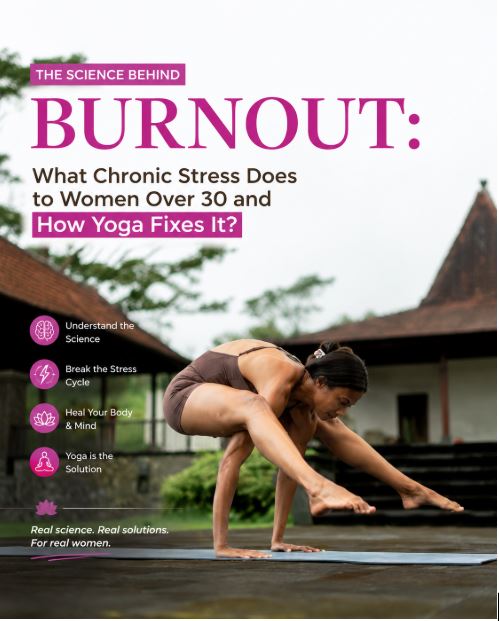
You're not imagining it. If you're a woman over 30 who feels tired even after sleeping, wired even when you're resting, and one calendar notification away from tears, that's not a productivity problem. That's your nervous system sending you a very specific, very physiological distress signal.
This isn't a "just relax" article. It's a look at what's actually happening inside your body during chronic stress, why it hits differently after 30, and what the research says about one of the few tools proven to reverse it: yoga for high-achieving women.
What Burnout Actually Is (It's Not Just "Being Tired")
The World Health Organization classifies burnout as an occupational phenomenon resulting from chronic workplace stress that hasn't been successfully managed. But burnout isn't confined to the office. It shows up in caregiving, in parenting, in the mental load of simply running a life, and it has three clinical markers:
- Emotional exhaustion: feeling drained before the day even starts
- Depersonalization or cynicism: feeling detached from work, relationships, or yourself
- Reduced sense of accomplishment: doing more and feeling like you're achieving less
The key thing to understand: burnout isn't a mindset issue. It's a dysregulated stress-response system. And that system runs on biology, not willpower.
The Biology of Chronic Stress: What's Actually Happening in Your Body
When you encounter a stressor (a deadline, a conflict, a 6 a.m. email), your hypothalamic-pituitary-adrenal (HPA) axis activates. Your adrenal glands release cortisol and adrenaline, your heart rate climbs, and your body prepares to respond to a threat.
This system is supposed to be short-lived. Stressor hits, cortisol spikes, threat resolves, cortisol drops. The problem is that modern stress (job pressure, financial strain, caregiving, always-on notifications) rarely "resolves." So the HPA axis stays switched on.
Chronic HPA axis activation is linked to:
- Elevated resting cortisol, which disrupts sleep architecture and blood sugar regulation
- Suppressed immune function, making you more prone to getting sick
- Reduced hippocampal volume over time, affecting memory and emotional regulation
- Increased inflammation, a driver of fatigue, brain fog, and mood disturbance
- Impaired vagal tone, meaning your parasympathetic ("rest and digest") system struggles to switch back on
This last point matters most, because it's the mechanism yoga directly targets. More on that below.
Why Women Over 30 Are Especially Vulnerable
Chronic stress doesn't affect everyone identically, and there's a real physiological reason women over 30 tend to feel it more acutely:
Perimenopause can begin as early as your mid-to-late 30s, and declining/fluctuating estrogen and progesterone directly affect cortisol regulation and sleep quality, meaning the same stressor produces a bigger physiological hit than it would have a decade earlier.
Allostatic load accumulates. This is the medical term for cumulative "wear and tear" from years of stress exposure. By your 30s and 40s, many women are carrying a decade or more of unresolved stress load on top of whatever's happening today.
The "sandwich" years. This is frequently the decade of peak career responsibility, caregiving for kids and aging parents simultaneously, and the highest cognitive load of anyone's adult life, often with the least amount of built-in recovery time.
This is why generic stress advice ("take a bubble bath," "get more sleep") tends to fall flat. It's not addressing the actual hormonal and nervous-system mechanics at play.
The High-Achiever Trap
There's a specific burnout pattern that shows up again and again in ambitious, high-performing women: the nervous system never gets a true "off" signal because the identity is built around output.
If you're a high-achieving woman, you likely recognize this loop:
- Stress → produce more to feel in control → temporary relief → stress returns, often worse
- Rest feels unproductive, even guilt-inducing, so the parasympathetic system rarely gets fully engaged
- Physical stress signals (tight jaw, shallow breath, disrupted sleep) get overridden because "there's no time to deal with that right now"
This is precisely why yoga for high achieving women needs to look different than a generic wellness recommendation. It's not about adding one more task to an already-full plate. It's about a practice that works with a driven nervous system rather than asking you to abandon your ambition to find calm.
The Science: How Yoga Actually Reverses the Stress Response
This is where it gets interesting, and where yoga stops being "a nice self-care activity" and starts being a legitimate physiological intervention.
1. Yoga directly increases vagal tone.
The vagus nerve is the primary communication channel of your parasympathetic nervous system, the "rest, digest, and repair" counterbalance to the stress response. Slow, controlled breathing (pranayama) and specific postures stimulate the vagus nerve, shifting the body out of sympathetic "fight or flight" mode and into a measurable state of physiological calm.
2. It lowers cortisol.
Research published in Annals of Behavioral Medicine found that a regular Hatha yoga practice was associated with significant reductions in perceived stress and salivary cortisol levels compared to a control group. A broader systematic review in the Journal of Psychiatric Research similarly found consistent reductions in cortisol and improvements in mood across multiple yoga-based interventions.
3. It increases GABA.
A study published in the Journal of Alternative and Complementary Medicine found that yoga practice was associated with increased GABA levels in the brain, a neurotransmitter that has a calming, anti-anxiety effect and is often depleted under chronic stress.
4. It improves heart rate variability (HRV).
Higher HRV is a well-established marker of nervous system resilience and stress recovery capacity. Consistent yoga practice has repeatedly been shown to improve HRV over time, meaning your body gets measurably better at recovering from stress the more consistently you practice.
In plain terms: yoga isn't a metaphorical reset. It's a direct, trainable intervention on the exact biological systems that chronic stress dysregulates.
What Does This Look Like in Practice?
The good news is that this doesn't require overhauling your life or finding two extra hours a day.
For women feeling the effects of chronic stress, the entry point is usually one of two things:
A consistent, guided practice you can do on your own schedule. If burnout has already left you running on empty, showing up to a fixed class time can feel like one more obligation. That's exactly the gap our On Demand library is built for: practices designed specifically around nervous-system regulation, so you can build consistency around your actual life rather than around a studio schedule.
In-person community and accountability. For many women, a regular class is the container that makes the practice stick. You can see what's currently running on our class schedule.
If you're specifically looking for yoga for burnt out women who need structure without added pressure, starting with 15–20 minutes of guided, restorative-leaning practice a few times a week is enough to begin shifting HRV and cortisol patterns. You don't need an hour-long power flow to get the physiological benefit.
Yoga for High-Achieving Women: A Different Entry Point
If your stress pattern looks more like the high-achiever loop described above, a group class or app isn't always the right starting point. You often need something built around your actual bandwidth and goals.
That's where private yoga sessions in Berkeley tend to work best: one-on-one work that meets you exactly where your stress response actually is, with a pace and focus tailored to a driven schedule rather than a generic one-size-fits-all class. It's a version of yoga for high-achieving women that treats your time and your nervous system with the same level of precision you bring to everything else.
For leaders managing this at a team level, this same science is also the foundation of our corporate wellness programs, because if you're a high-achieving woman managing other high-achieving people, the burnout pattern is rarely isolated to just you.
FAQ: Burnout, Stress, and Yoga
Does yoga actually lower cortisol, or is that just a wellness claim?
It's backed by peer-reviewed research. Multiple studies, including a controlled trial published in Annals of Behavioral Medicine, have measured statistically significant reductions in salivary cortisol after consistent yoga practice, alongside improvements in perceived stress.
Why does chronic stress feel worse for women after 30 than it did in their 20s?
Perimenopausal hormonal shifts (which can begin in your mid-to-late 30s) interact directly with cortisol regulation, and years of accumulated "allostatic load" mean the same stressor produces a stronger physiological response than it would have earlier in life.
How much yoga do I need to actually see stress relief, not just feel relaxed for an hour?
Research generally shows measurable improvements in cortisol and heart rate variability with consistent practice of 15–30 minutes, 3–4 times a week, over several weeks. Consistency matters more than session length.
Is yoga enough on its own to fix burnout?
Yoga is a powerful tool for regulating the nervous system's response to stress, but burnout recovery is usually multi-factorial: sleep, workload, and support systems matter too. Yoga addresses the physiological piece that most burnout advice ignores.
What's the difference between yoga for burnt out women and a regular yoga class?
The goal shifts from fitness or flexibility to nervous-system regulation: slower pacing, more breathwork, and postures chosen specifically to activate the parasympathetic response rather than to build heat or intensity.
About the Author
This article was reviewed by Dr. Lisa Eshun-Wilson, founder of Yoga with Lisa and holder of a PhD in Molecular and Cell Biology from UC Berkeley. Lisa combines a science background with over a decade of teaching experience to build yoga programs specifically designed around the physiology of stress for the women navigating deadlines, caregiving, and everything in between.
Feeling the effects of chronic stress right now? Start with a guided practice from our On Demand library, or book a call to talk through whether private sessions or corporate wellness is the right fit for where you're at.